Smart Ordering App for All-You-Can-Eat Restaurants

Work in progress

Role

UX/UI Designer

Industry

Food

Team

Cross-functional
During a business trip to Germany, I ended up at an all-you-can-eat sushi place (a dream, right?). As I watched plates pile up and waiters rush around with paper menus, I couldn’t help but think—there has to be a better way to do this.

That little sushi outing got me thinking about how many restaurants struggle with food waste and clunky service. What if we could make the whole experience more efficient and enjoyable—for both the staff and the hungry customers like me? 🍣💡

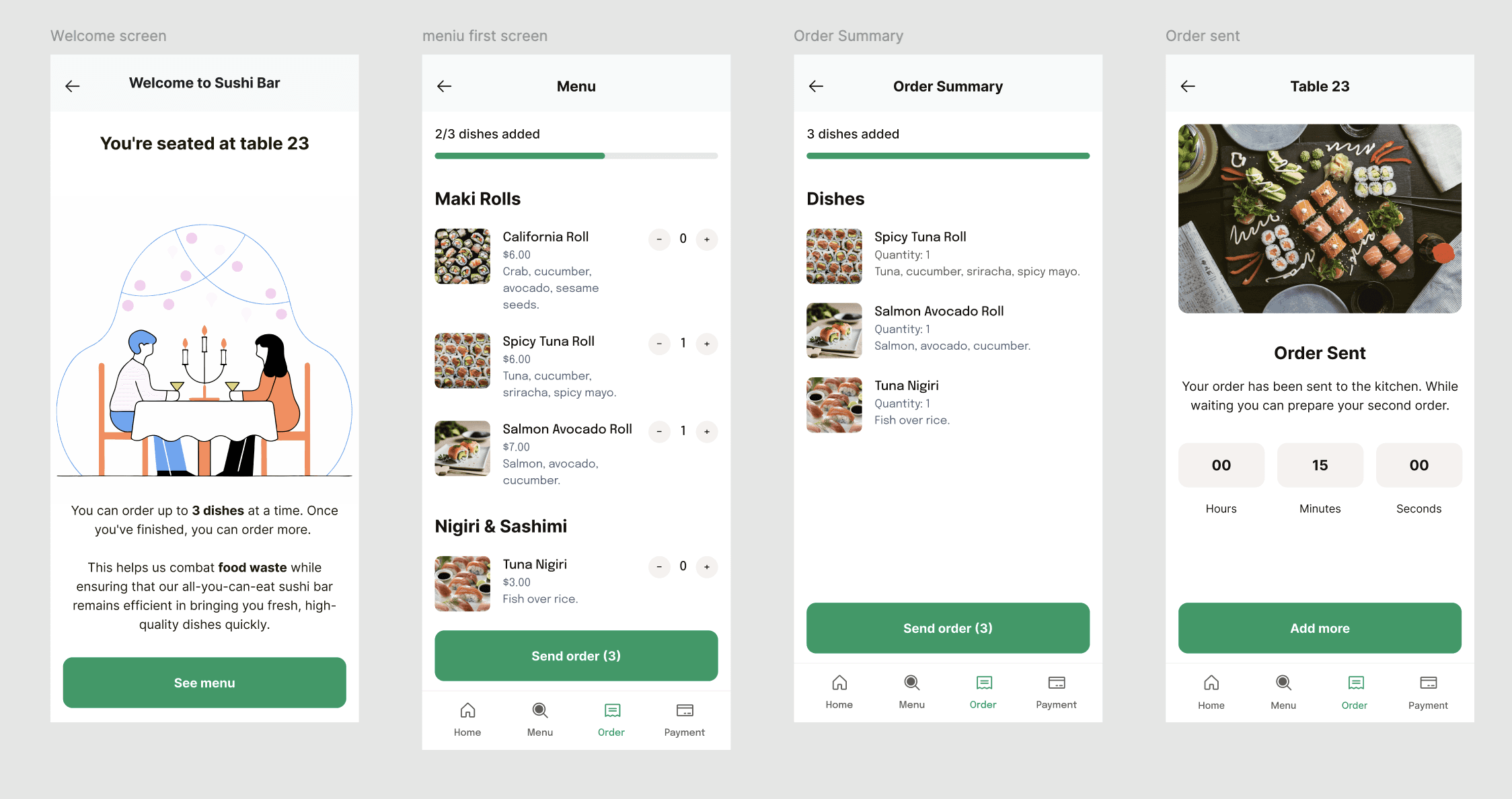
Screens sneak peek

Problem Statement

Many all-you-can-eat restaurants struggle with food waste and service inefficiencies. Customers often order excessive portions, leading to unnecessary waste. Additionally, traditional paper-based menus require frequent replacement, slowing down the ordering process and creating additional workload for waiters.

Project Goal

Develop a mobile ordering app that streamlines food selection, reduces waste, and optimizes restaurant operations by providing a real-time digital menu accessible via QR code. The app will:

  • Allow customers to track their current order and adjust it accordingly.

  • Send orders directly to the kitchen, reducing wait times and miscommunication.

  • Encourage mindful consumption by limiting excessive ordering through visual tracking.

During a business trip to Germany, I ended up at an all-you-can-eat sushi place (a dream, right?). As I watched plates pile up and waiters rush around with paper menus, I couldn’t help but think—there has to be a better way to do this.

That little sushi outing got me thinking about how many restaurants struggle with food waste and clunky service. What if we could make the whole experience more efficient and enjoyable—for both the staff and the hungry customers like me? 🍣💡

Screens sneak peek

Problem Statement

Many all-you-can-eat restaurants struggle with food waste and service inefficiencies. Customers often order excessive portions, leading to unnecessary waste. Additionally, traditional paper-based menus require frequent replacement, slowing down the ordering process and creating additional workload for waiters.

Project Goal

Develop a mobile ordering app that streamlines food selection, reduces waste, and optimizes restaurant operations by providing a real-time digital menu accessible via QR code. The app will:

  • Allow customers to track their current order and adjust it accordingly.

  • Send orders directly to the kitchen, reducing wait times and miscommunication.

  • Encourage mindful consumption by limiting excessive ordering through visual tracking.

Framing the Problem – 5Ws Framework

WHO is affected?

  • Customers: Want a convenient, easy-to-use ordering system without overordering.

  • Waiters: Reduce back-and-forth trips, focus more on customer experience.

  • Chefs: Get clear, real-time orders with better demand forecasting.

  • Restaurant Owners: Reduce food waste and optimize staff efficiency.

WHAT is the main issue?

  • Overordering leads to high food waste and extra costs.

  • Waiters spend excessive time taking and clarifying orders.

  • The kitchen struggles with unclear or delayed orders.

WHEN does this problem occur?

  • During peak hours when order mismanagement leads to delays.

  • When customers overestimate how much they can eat.

  • When menu items are unavailable but not updated on paper menus.

WHERE does this happen?

  • All-you-can-eat restaurants (especially sushi, BBQ, buffets).

  • Places with high customer turnover and large group dining.

WHY is this important?

  • Food waste is an environmental and financial concern.

  • Digital solutions improve accuracy and efficiency in order management.

  • Enhancing the customer experience leads to higher satisfaction and repeat visits.
Research Methodology

To ensure the app effectively addresses food waste and optimizes restaurant efficiency, I would use a mixed-methods research approach, combining qualitative and quantitative techniques.

User Research

  1. Surveys & Questionnaires (Quantitative)

    Target: Restaurant customers, waiters, chefs, and managers.

    Goal: Identify common issues in ordering, food waste patterns, and service inefficiencies.

    Key Metrics:

    • How much food is left uneaten per order?

    • What ordering difficulties do customers face?

    • How do waiters perceive current order management challenges?


  2. Interviews & Focus Groups (Qualitative)

    Target: Regular customers, restaurant staff, and managers.

    Goal: Gain deeper insights into behaviour, expectations, and pain points.

    Example Questions:

    • "What factors influence how much you order?"

    • "How often do you leave food uneaten at an all-you-can-eat restaurant?"

    • "What would make ordering more convenient for you?"

Observational Research

  1. Shadowing Waiters & Kitchen Staff

    • Observing order flow, bottlenecks, and miscommunications between waiters and the kitchen.

    • Tracking how much food is discarded post-service.


  2. Customer Ordering Behavior Analysis

    • Monitoring how customers interact with traditional paper menus and how frequently they adjust their orders.

    • Identifying trends in overordering and food waste.

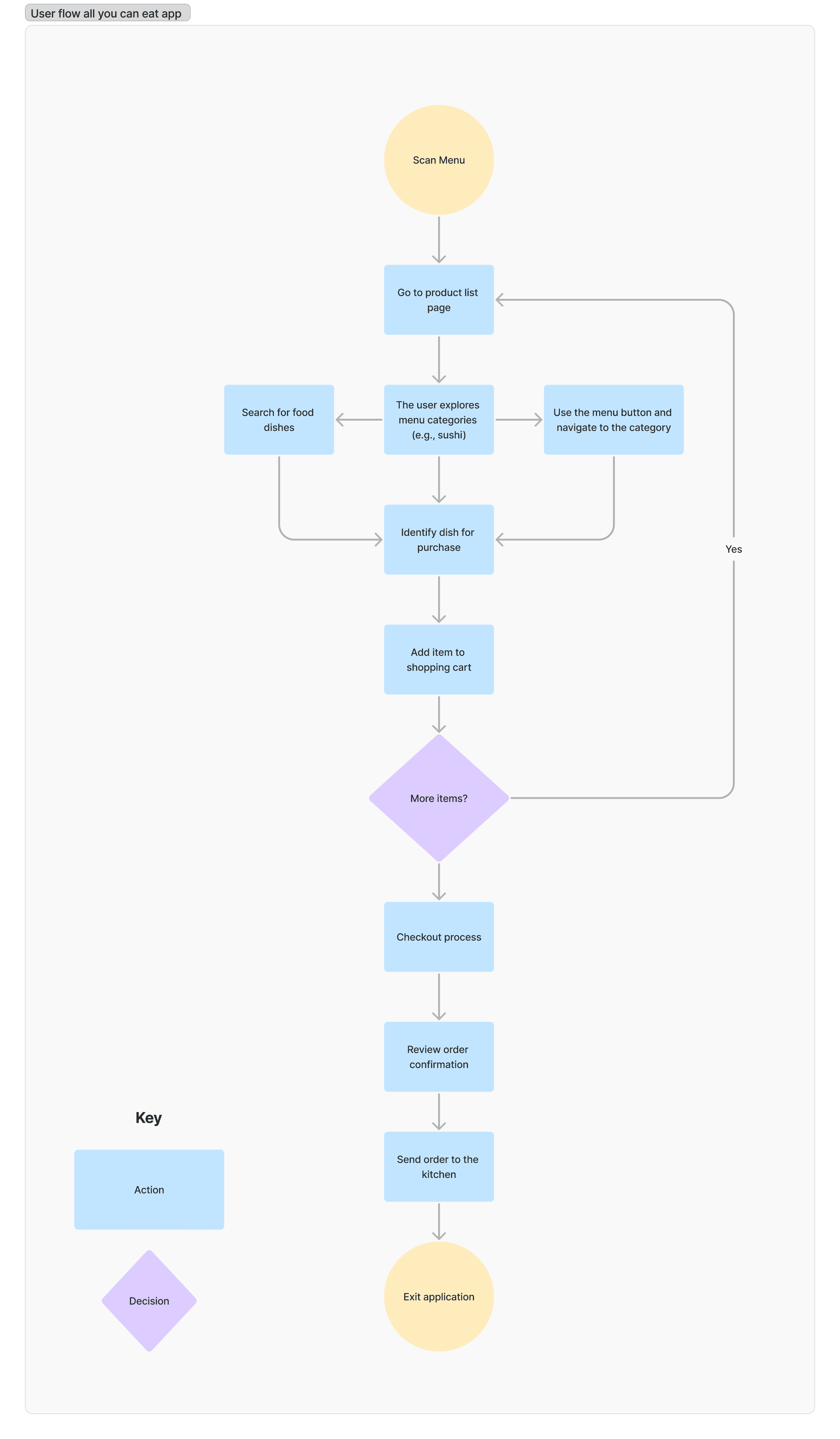
User Flow

Usability Testing

  1. Wireframe Testing

    • Develop a prototype of the app and test it with real users.

    • Observe how easily customers navigate menu selection, order adjustments, and tracking consumption.


  2. Pilot Testing at a Partner Restaurant

    • Implement the app in a real restaurant environment for a test period.

    • Collect feedback on how it impacts food waste, order efficiency, and staff workload.

4. Data Analysis

  • Comparative Study (Before vs. After App Implementation)

    • Track food waste reduction percentage.

    • Measure average ordering time per table.

    • Analyze customer satisfaction scores before and after implementation.

Research Methodology

To ensure the app effectively addresses food waste and optimizes restaurant efficiency, I would use a mixed-methods research approach, combining qualitative and quantitative techniques.

User Research

  1. Surveys & Questionnaires (Quantitative)

    Target: Restaurant customers, waiters, chefs, and managers.

    Goal: Identify common issues in ordering, food waste patterns, and service inefficiencies.

    Key Metrics:

    • How much food is left uneaten per order?

    • What ordering difficulties do customers face?

    • How do waiters perceive current order management challenges?


  2. Interviews & Focus Groups (Qualitative)

    Target: Regular customers, restaurant staff, and managers.

    Goal: Gain deeper insights into behaviour, expectations, and pain points.

    Example Questions:

    • "What factors influence how much you order?"

    • "How often do you leave food uneaten at an all-you-can-eat restaurant?"

    • "What would make ordering more convenient for you?"

Observational Research

  1. Shadowing Waiters & Kitchen Staff

    • Observing order flow, bottlenecks, and miscommunications between waiters and the kitchen.

    • Tracking how much food is discarded post-service.


  2. Customer Ordering Behavior Analysis

    • Monitoring how customers interact with traditional paper menus and how frequently they adjust their orders.

    • Identifying trends in overordering and food waste.

User Flow

Usability Testing

  1. Wireframe Testing

    • Develop a prototype of the app and test it with real users.

    • Observe how easily customers navigate menu selection, order adjustments, and tracking consumption.


  2. Pilot Testing at a Partner Restaurant

    • Implement the app in a real restaurant environment for a test period.

    • Collect feedback on how it impacts food waste, order efficiency, and staff workload.

4. Data Analysis

  • Comparative Study (Before vs. After App Implementation)

    • Track food waste reduction percentage.

    • Measure average ordering time per table.

    • Analyze customer satisfaction scores before and after implementation.

Other projects

Andreea Mahalean

Copyright 2025 by Andreea Mahalean

Andreea Mahalean

Copyright 2025 by Andreea Mahalean

Andreea Mahalean

Copyright 2025 by Andreea Mahalean